

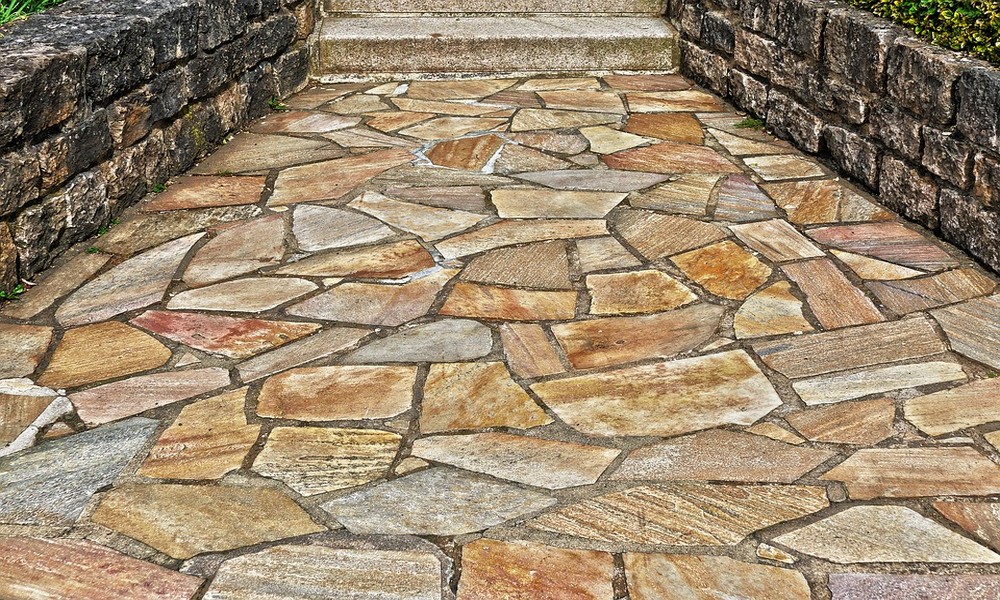
Landscape flagstone is one of those materials that earns its place in nearly every style of outdoor and indoor design without ever looking out of place. It’s natural, durable, and carries a visual weight that manufactured materials have spent decades trying to replicate without quite getting there. Whether you’re working with sandstone, slate, limestone, quartzite, or bluestone, the character of the material does a lot of the design work on its own. The challenge isn’t making flagstone look good. It’s choosing the right application and installing it correctly so it performs as well as it looks. These are the uses where flagstone consistently delivers.
1. Patios
A flagstone patio is one of the most popular and enduring applications for the material, and for good reason. The irregular shapes and natural color variation create a surface that looks like it’s always belonged in the landscape rather than something recently installed. Flagstone patios work equally well in formal garden settings where stones are cut to precise dimensions and set in tight joints, and in casual, naturalistic designs where irregular shapes are fitted together with wider gaps filled by gravel, ground cover, or creeping thyme.
The material’s durability is a major asset in a patio application. Properly set flagstone handles freeze-thaw cycles, furniture weight, foot traffic, and decades of weathering without the cracking and surface degradation that concrete patios often develop over time. It doesn’t fade, it doesn’t peel, and it actually tends to look better as it ages. The upfront cost is higher than poured concrete or pavers, but the longevity and the way the material holds its appearance over decades makes it a sound long-term investment for homeowners who won’t want to resurface or replace the patio in 15 years.
Installation method matters significantly for patio performance. Flagstone set on a dry-laid gravel and sand base handles ground movement well and drains naturally, which is particularly valuable in climates with significant frost heave. Wet-set flagstone on a concrete base provides a more stable, uniform surface better suited to formal settings or heavy furniture, but it requires proper drainage planning to avoid moisture problems underneath the slab over time.
2. Walkways and Garden Paths
Flagstone walkways are one of the most approachable flagstone projects and one of the most rewarding. A well-laid garden path with flagstone stepping stones set into lawn or ground cover creates the kind of casual, inviting feel that formal concrete or brick paths don’t quite achieve. The visual effect is of a path that the garden grew around rather than one imposed on it, which is exactly what most residential landscape designs are trying to accomplish.
For walkways with regular foot traffic, stepping stones should be set at a consistent depth with stable bases so they don’t rock underfoot or settle unevenly over time. Spacing matters too. Stones set too far apart force awkward strides, while stones set too close together lose the rhythm that makes a flagstone path feel natural. A stride-length spacing of roughly 18 to 24 inches between the centers of stepping stones tends to feel comfortable for most adults without looking cluttered.
Flagstone paths also give landscape designers a practical tool for managing lawn wear patterns. Rather than watching grass die off along a desired traffic route, a flagstone path formalizes the path people are already taking and protects the surrounding plantings. It’s one of those applications where function and aesthetics reinforce each other completely, and the result tends to add more perceived value to a property than the installation cost would suggest.
3. Pool Decking
Flagstone is one of the best materials available for pool deck applications, and it’s a common choice among landscape designers working on higher-end residential and commercial pool installations. The natural surface texture of flagstone provides traction when wet without requiring the addition of aggregate or anti-slip coatings that can wear off over time. Its thermal properties also work in the swimmer’s favor. Flagstone stays cooler underfoot than concrete or brick in direct sun, which matters significantly on a hot summer afternoon when bare feet are crossing the deck repeatedly.
The material’s aesthetic compatibility with water is hard to quantify but easy to recognize. The natural color variation and irregular texture of flagstone complement the visual quality of water in a way that poured concrete never quite does. Bluestone in particular is a popular pool deck choice because its cool blue-gray tones echo the color of pool water in a way that makes the whole space feel cohesive and intentional.
Flagstone pool decks require careful installation with appropriate drainage slope and, in most cases, wet-setting over a concrete base to maintain a stable, level surface around the pool perimeter. Joints should be grouted or tightly fitted to prevent tripping hazards and to keep the deck surface predictable underfoot. With proper installation and appropriate sealing for the stone type, a flagstone pool deck will outperform concrete in appearance and longevity with relatively minimal maintenance.
4. Retaining Walls
Stacked flagstone retaining walls are a functional and visually compelling alternative to concrete block or timber walls for managing grade changes in landscaped areas. A dry-stacked flagstone wall, built without mortar and relying on gravity, weight, and careful stone selection, handles ground movement and water pressure naturally because it’s inherently flexible and permeable. That flexibility is an advantage in climates with significant freeze-thaw activity, where rigid mortared walls often crack and fail over time.
The visual character of a stacked flagstone wall is difficult to replicate with manufactured materials. The combination of irregular shapes, varied textures, and natural color shifts creates the kind of depth and interest that concrete block walls simply don’t have, regardless of what surface treatment is applied. A well-built flagstone retaining wall looks permanent and established from the day it’s completed, and it tends to look increasingly natural as the surrounding planting fills in around it.
Building a structurally sound flagstone retaining wall requires more skill and patience than many people anticipate. Stone selection, batter angle, base preparation, and proper backfill drainage all affect long-term performance. Walls taller than about 18 inches typically benefit from professional installation, particularly on slopes where soil pressure and water management become more critical factors. For shorter decorative walls and garden borders, dry-stacked flagstone is a manageable project that produces a result no manufactured alternative can match.
5. Outdoor Steps and Staircases
Flagstone steps integrate into natural and formal landscapes with equal ease, and they’re one of the most visually satisfying transitions between grade changes in residential design. Whether they’re wide, shallow steps cut from large single slabs or stacked risers built from layered pieces, flagstone stairs carry a permanence and substance that poured concrete steps rarely achieve and that wooden steps simply don’t last long enough to provide.
The proportions of flagstone steps are critical to both safety and aesthetics. A comfortable exterior stair typically uses a riser height of four to six inches and a tread depth of at least 12 inches, with wider, shallower proportions feeling more relaxed and appropriate for garden settings than the steeper proportions common in interior residential stairs. Flagstone’s availability in large-format slabs makes it well suited to wide, generous treads that invite a slower, more deliberate pace and give a landscape a sense of grandeur without requiring it anywhere else.
For installations in cold climates, tread thickness matters. Flagstone treads should be at least two inches thick to resist cracking under freeze-thaw stress, and the base preparation needs to account for frost depth in the local soil. Properly built flagstone stairs require virtually no maintenance and will outlast the landscape they serve, which is exactly what a high-traffic hardscape element should do.
6. Interior Flooring
Flagstone’s appeal isn’t limited to outdoor spaces. Interior flagstone flooring carries a warmth and texture that ceramic and porcelain tile haven’t been able to fully replicate despite years of advances in digital printing technology. In entryways, mudrooms, sunrooms, kitchens, and great rooms with direct outdoor access, flagstone flooring creates a visual and material continuity between inside and outside that’s particularly effective in homes with strong indoor-outdoor design intent.
Slate is one of the most common interior flagstone choices because of its relatively uniform thickness, its natural resistance to moisture, and its color range that includes deep charcoal, copper, purple, and green tones that coordinate well with a wide range of interior palettes. Sandstone and limestone bring warmer tones more appropriate for traditional and Southwestern interiors. Quartzite offers hardness and durability that holds up well under heavy residential traffic and resists scratching better than softer stone types.
Interior flagstone floors require sealing to protect against staining, particularly in kitchen and dining applications where spills are frequent. The right sealant depends on the stone type. Some stones require penetrating sealers that don’t alter the surface appearance, while others benefit from enhancing sealers that deepen the natural color and sheen. Properly sealed and maintained, a flagstone floor develops a patina over time that adds character rather than showing wear, which is the defining quality that separates natural stone from its manufactured alternatives.
7. Fire Pit Surrounds and Outdoor Fireplaces
Flagstone is a natural fit around fire features, both functionally and visually. The material handles the thermal cycling of a regularly used fire pit without cracking or spalling the way concrete does over repeated heating and cooling cycles, and it stays cool enough on the surrounding deck surface to be comfortable for guests gathered around the fire. The natural, earthy quality of flagstone also reinforces the elemental character of a fire feature in a way that poured concrete or manufactured pavers often undermine.
For fire pit surrounds, flagstone is typically dry-laid in a ring around the pit with the inner stones selected and set to frame the fire bowl cleanly. The surrounding flagstone deck serves as both a functional seating area and a visual boundary that defines the fire pit as a deliberate destination in the landscape rather than a freestanding element sitting on an otherwise undifferentiated surface. That sense of place, of a feature designed into the landscape rather than placed on top of it, is one of the consistent contributions flagstone makes across applications.
Outdoor fireplace construction with flagstone veneer over a structural masonry or concrete block core is a more involved application that produces one of the most dramatic results possible in a residential outdoor living space. The irregular texture and warm tones of a flagstone-veneered fireplace face create a focal point that anchors the entire outdoor living area and gives the space the kind of permanence that distinguishes a designed outdoor room from a collection of furniture on a patio.
8. Accent Walls and Interior Veneer
Flagstone veneer on an interior accent wall adds texture, depth, and visual mass to a room in a way that paint, wallpaper, and wood paneling can’t replicate. Living rooms, dining rooms, home bars, and wine cellars are particularly well-suited to flagstone veneer applications, where the material’s natural variation creates a surface that holds visual interest without requiring additional decoration. A single flagstone accent wall in a living room can anchor a space and establish a design direction that everything else in the room responds to.
The weight of full-thickness flagstone limits interior veneer applications to walls with appropriate structural support, which is why most interior installations use thin-cut veneer stone in the half-inch to one-inch range rather than full-thickness slabs. The visual result is virtually identical to full-thickness flagstone, and the lighter weight makes it compatible with standard wall framing without the reinforcement requirements of heavier installations. Proper substrate preparation and a mortar system appropriate for the stone type are critical to preventing veneer failure, particularly in areas subject to humidity fluctuation.
Fireplace surrounds and hearths are among the most popular interior flagstone veneer applications, where the material’s heat tolerance, visual weight, and natural character combine to create a fireplace that looks genuinely substantial rather than cosmetic. A well-executed flagstone fireplace surround is one of the interior design details that tends to hold its value indefinitely. It reads as permanent and quality regardless of what design trends come and go around it.
The Case for Flagstone Is Simple
Natural materials outperform manufactured alternatives in one dimension that’s genuinely difficult to quantify but easy to recognize: they look real. Flagstone doesn’t try to approximate the appearance of something more expensive or more refined. It is what it is, a piece of the earth cut and shaped for a specific purpose, and that authenticity is exactly what makes it compelling across such a wide range of applications. Whether it’s underfoot on a patio, framing a pool, stacked into a wall, or covering a floor inside a home, flagstone earns its place by looking like it was always supposed to be there.